



Franco Moschino understood that fashion was too serious a business not to be laughed at. In the 1980s, at the height of conspicuous luxury, he turned clothes into a running commentary: a Chanel-like suit embroidered with “This is a Waist of Money,” a little black dress carrying its own price tag, buttons replaced by windmills, skirts made from neckties, a bag announcing “This Is Not an It Bag.” His jokes were rarely gratuitous. They were a way of taking fashion apart from the inside, exposing its vanities and absurdities by exaggerating them until they became impossible not to see. He turned sophisticated semantic wit and jeu de mots into slogans without ever sounding pretentious; he didn’t want to lecture. And his irreverence was grounded in technique: Moschino could parody couture because he knew exactly how it worked, translating trompe-l’œil and pop references into not just astute critiques, but chic, wearable collections.
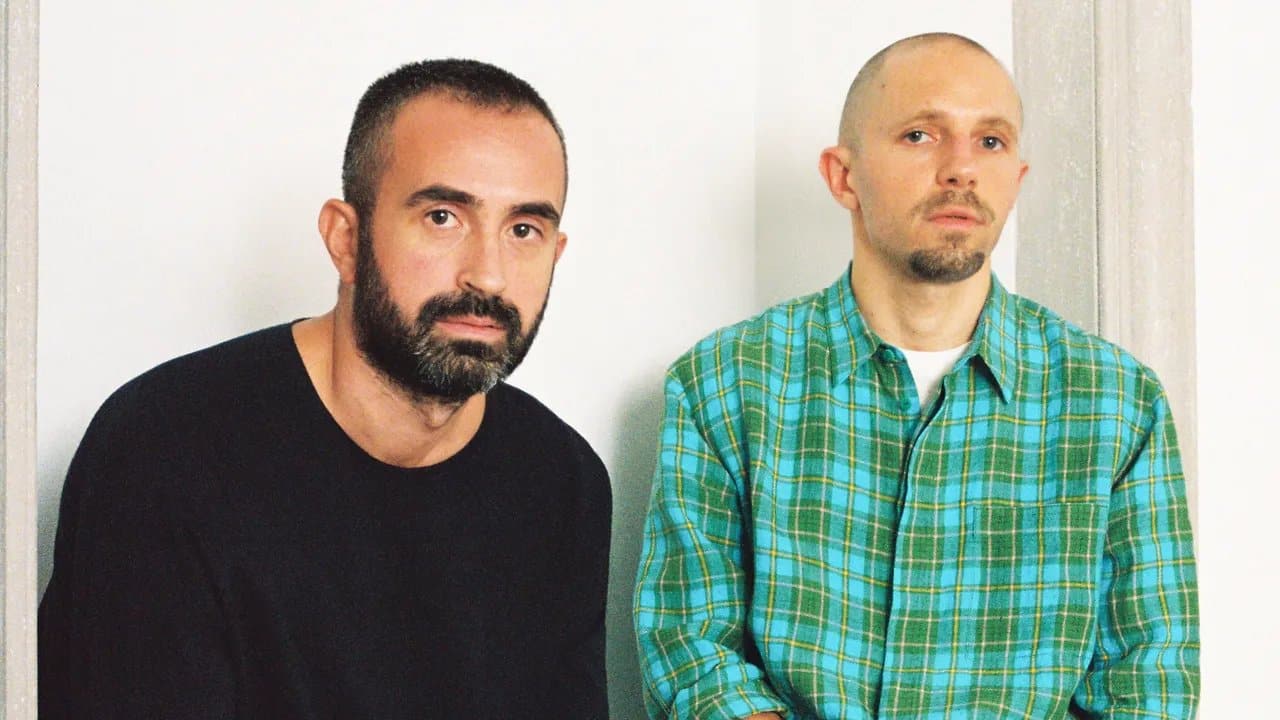
It’s this Franco Moschino, not simply the man of the smiley face, the sardonic T-shirt, and the deliberately outrageous accessory, that Simone Rizzo and Loris Messina have been considering since taking over the creative direction of the house last June, following in the footsteps of Rossella Jardini, Jeremy Scott, and Adrian Appiolaza. The former Sunnei designers have been in their new role for barely two months, and their first instinct has been not to make noise but to listen. “We are meticulously studying why Moschino made sense,” they said at a preview at the brand’s headquarters (the designers prefer to be quoted in unison). “But we don’t want to replicate it. We want to understand it in order to create the Moschino of the future.”
It’s a deceptively simple distinction. For a house whose visual vocabulary has become so recognizable that its own jokes can easily become clichés, the temptation is to turn the archive into a dressing-up box: pick a slogan, throw in a windmill, and call it Moschino. Rizzo and Messina are taking the opposite route. They have looked at the clothes, studied their construction, and, as they put it, “metabolized” what they found. The objective is not reproduction. “We don’t want to reproduce anything he did literally. The only thing we are carrying forward is his spirit and his way of thinking.”
That may be the most revealing thing they’re saying about their new appointment. Because if Franco’s humor has been endlessly imitated, his method has been considerably less so. Rizzo and Messina are interested in the machinery beneath the joke. “For us it is fundamental that irony is in the concept,” they explained. “If irony is in the product, it becomes ornament.”
The difference matters. It’s also where their own history with Sunnei comes into play. For 12 years, Rizzo and Messina built a label outside the traditional fashion system, then proceeded to spend much of their time dismantling its conventions from within. They staged shows in which a voice-over talked about what models were actually thinking while walking, audiences voted on what they saw, and crowdsurfing became part of the performance. Their shows were not simply presentations of clothes but experiments in how fashion and its audience could behave.
Now, as they both approach 40, they describe themselves with characteristic self-deprecation as “two serious rompipalle”—two serious pains in the neck. The expression is less frivolous than it sounds. Their punk instinct has not disappeared; it has simply acquired a little more perspective, and more resources to make it happen.
“We have always been spaccapalle, not really simpatico,” they say. “We were born outside the system and became anti-system, even though now we are inside it up to our necks.” After years spent driving their own fashion workhorse, they’re suddenly discovering that they are behind the wheel of a racing machine. “At Sunnei we were used to driving a Fiat 500,” they joke. “Now we are driving a Maserati.” The joke comes with an appreciation of what the machinery of a historic Italian fashion house can make possible. They praise the high level of manufacturing at parent company Aeffe, which gives them the opportunity to build a wardrobe whose conceptual intelligence is matched by an equally exacting standard of execution.


