



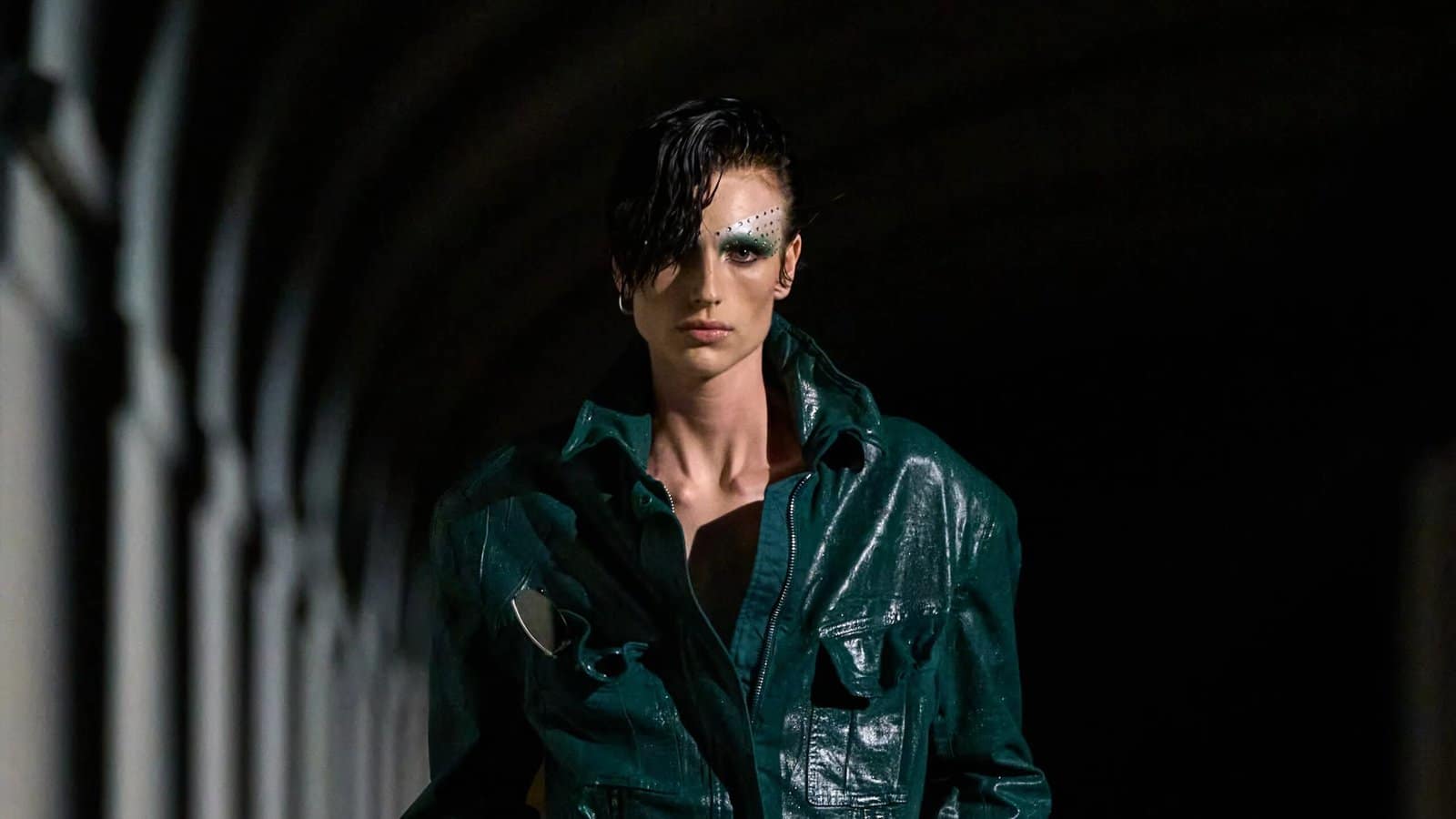
Ten years of The Attico, and what better place to celebrate than in bed? Except there were many of them: a long line of beds running through a dark tunnel, piled with pillows and tangled sheets, with the audience sitting right on them. The lighting came in sudden cabaret flashes, revealing models who looked as though they had just slipped out of someone’s bedroom, or perhaps hadn’t quite decided whether to leave. If the whole thing sounds Freudian, it was hard to argue otherwise. Gilda Ambrosio and Giorgia Tordini, however, insisted the beds had nothing to do with sex. They were about intimacy, they said, the private space where you can be whoever you want without judgment. Freud, presumably, wasn’t consulted.
The starting point was Gabriel García Márquez’s idea that we all have three lives: a public one, a private one and a secret one. The Attico went straight for the latter, the self you don’t necessarily show, or perhaps don’t even know you are. It was a procession of alter egos: a gothic creature with a constellation of piercings, another dusted in light-catching shimmer, one straight out of a 1980s nightclub apparition. Nobody seemed to have arrived as themselves. Or perhaps everyone had.
The clothes appeared to have escaped from the same bedrooms. Some girls looked as though they had gone to bed dressed and then simply walked out before morning, still crushed from the sheets. Fabrics were molded, twisted and wrinkled around the body. Even the beds were deliberately undone. “How many times have you wanted to go out in your pajamas?” the designers asked. Quite often, one suspects, if the pajamas happen to be The Attico.
The dressing gown, one of the brand’s original signatures, returned with considerably more drama than anyone needs from a garment designed for breakfast. Layers of luscious fabric made the vestagliaalmost operatic, while velvet, a sensuous signature from Attico’s early days, brought the anniversary full circle. There was leather, vintage-inflected sequined numbers, military tailoring, furry wraps, utility zippers, masculine shirts and shoulders with an attitude problem. “The shoulder is proud,” they said. “It’s never a sad shoulder.” Quite.
If anything, the designers had lost interest in the bottom half. “Last year we forgot the jackets; this year we forgot the trousers,” they joked. There were, technically, trousers and skirts. But the point was clear: after 10 years, The Attico is less interested in maintaining a fixed silhouette than in letting its women change personalities.
Iridescent, rigid fabrics recalled vintage curtains; one piece was inspired by the upholstery of an armchair. Seventies photographs of women in beds supplied the attitude, Saint Laurent the liberated sensuality, and a little kink added the mandatory frisson. The designers maintained that the kink had nothing to do with the beds. Which was probably wise, given that we were all sitting on them.
The collection felt less like an homage to ‘look how far we’ve come’ than a rummage through the Attico archive with the good sense not to put everything back in the same place or all at once. What made it feel most “Attico core,” as they called it, was its refusal to settle on a single woman. “You can choose which woman you want to be, or which woman you feel you are,” they said. After a decade, that may be the brand’s most convincing proposition: not a signature silhouette, but a wardrobe of personalities.
Ten years ago, the designers were working wherever they could, often in hotel rooms. Today there was a full backstage of professionals and a company built around them. The anniversary was less a retrospective than a reunion with all the women The Attico has invented along the way. Freud may have had his theories about beds, secrets and the unconscious. The Attico has its own: give a woman a bed, a wardrobe and an audience, and she will probably misbehave while looking awfully good.


