



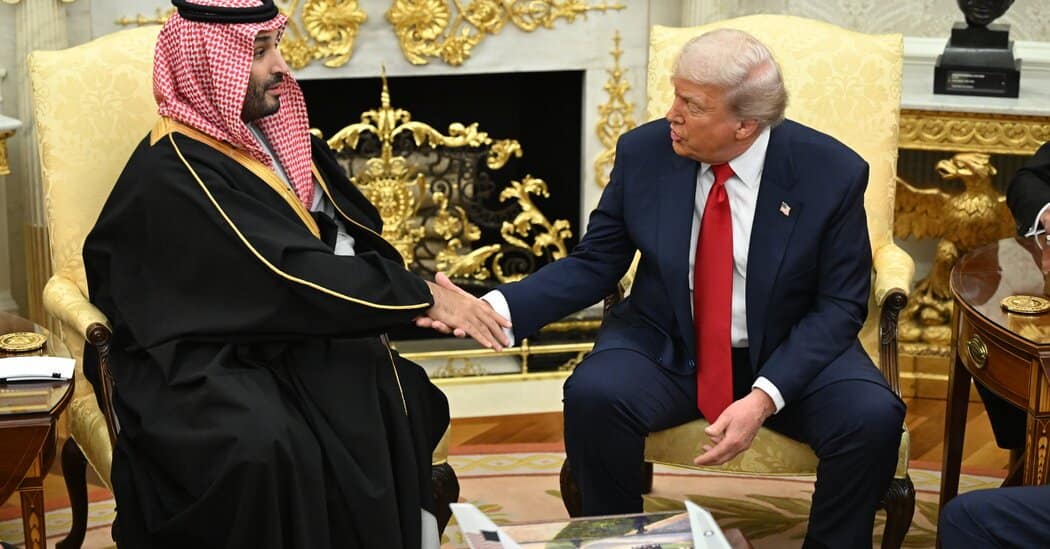
The Trump administration plans to announce Wednesday that it has reached a broad nuclear agreement with Saudi Arabia that could lead to the country enriching its own fuel for nuclear reactors, U.S. officials said. The move is likely to trigger a debate over whether the Saudi government can be trusted with a technology that can also be used to produce nuclear weapons.
The accord is intended to further bind the United States with the Saudi government as the war with Iran strains the relationship. The Trump administration, according to officials, thinks it will provide billions of dollars for the U.S. nuclear industry — starting with Westinghouse, which designs many of the reactors sold abroad.
The Trump administration plans to formally sign and announce the agreement with the Saudis on Wednesday, said two U.S. officials, who spoke on the condition of anonymity to discuss sensitive diplomacy. It would tell the details to Congress soon afterward. Although the agreement would have support among many Republicans there, some U.S. lawmakers from both parties and Israeli officials have expressed opposition to such a plan, fearing that the kingdom could use a civilian nuclear project to eventually develop nuclear weapons.
The accord has been under discussion for years, and during the Biden Administration it was envisioned as part of a broader agreement that would include Saudi diplomatic recognition of Israel. But after the Oct. 7, 2023, attacks on Israel by Hamas, that prospect receded. President Trump separated the proposal for U.S.-Saudi civilian nuclear cooperation from any demand that Saudi Arabia recognize Israel.
The agreement will require review by Congress, which under the Atomic Energy Act has the power to vote a resolution of disapproval. But as a practical matter, the agreement would likely pass, because Congress would have to assemble a veto-proof majority to override Mr. Trump’s initiative.
Nonetheless, debate over the accord — called a 1-2-3 Agreement — is likely to be fierce. To get the deal done with Crown Prince Mohammed bin Salman, the country’s 40-year-old de facto leader, Mr. Trump had to agree to terms that may limit international inspectors from going to any sites in the country that they think might be a pathway to diverting fuel to weapons projects.
And he agreed that, after a joint study with Saudi Arabia on the economics of producing nuclear fuel, the Saudis may be allowed to enrich uranium or reprocess plutonium on their soil.
Those are huge concessions. When the United States entered into a similar 1-2-3 agreement with the United Arab Emirates, which went into force in 2009, there were far more restrictive conditions. The U.A.E. agreed to the stringent inspections, signing what is called an “additional protocol” with the International Atomic Energy Commission. And it agreed to forgo, forever, the right to produce its own fuel, cutting off the possibilities that it would have the infrastructure to produce a weapon.
That agreement became known as the “gold standard” for nuclear non-proliferation. And while the administration plans to argue that it will have other restrictions in place — including joint partnerships with the Saudis that will allow Washington to keep a close eye on the kingdom’s program — the fact remains that Mr. Trump has retreated from the restrictions negotiated by the Bush and Obama administrations.
While the bulk of the negotiations with the U.A.E. took place while President George W. Bush was in office, it was finished by President Barack Obama and went into effect in 2009.