




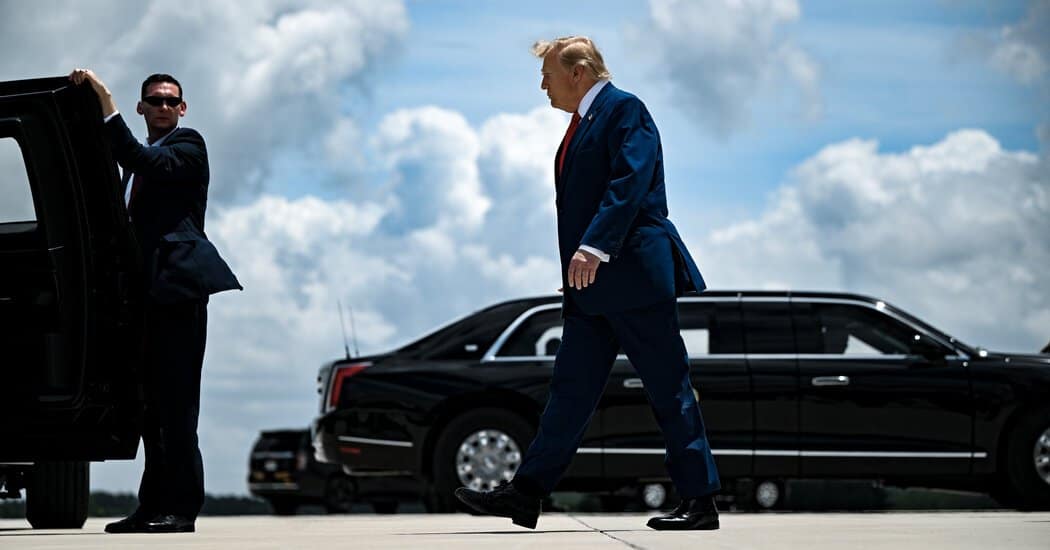
“The Deal with the Islamic Republic of Iran is now complete. Congratulations to all!”
That was how President Trump announced a cease-fire with Iran on June 14 that halted U.S. combat operations and reopened the Strait of Hormuz to commercial shipping.
Mr. Trump was pleased with the deal, which promised to wrap up a conflict he had promised would be over quickly and ease a spike in U.S. gas prices. “Ships of the World, start your engines. Let the oil flow!” he wrote.
Within a month the agreement was in shambles. U.S. and Iranian forces are again trading strikes, and ships are once more avoiding the strait for fear of Iranian attacks. After a substantial drop in recent weeks, the price of oil again broke $100 on Thursday.
What went wrong? Here is how things unraveled.
The cease-fire kicks in
Mr. Trump’s deal with Iran, signed on June 17, initially looked to be a success.
The United States stopped bombing and allowed Iran to temporarily sell and ship its oil. Iran at first did not interfere with ships sailing through the strait. Global oil prices plunged as tankers again sailed through the vital waterway.
But analysts warned that the 14-point document establishing the cease-fire was dangerously vague. While Mr. Trump said it restored freedom of navigation in the strait, Iran made clear that it considered itself in control of the international waterway.
On June 21 Vice President JD Vance flew to Switzerland to kick off talks with Iranian officials, outlined by the cease-fire agreement, for a more comprehensive deal that would determine the long-term future of the strait and of Iran’s nuclear program.
Trouble in the strait
But the strait did not quite return to normal.
Iranian mines laid early in the war still posed a threat in the longtime official shipping route through the middle of the strait, rendering that path unsafe. Their removal would take time.
Two alternate routes emerged. Most ships used a southern route close to Oman designated by a U.N. maritime agency. The U.S. military provided guidance and some air support to protect ships from Iranian mines and potential attacks.
But Iran insisted that ships use a northern route along its coast that it had established before the cease-fire. Iran charged fees for sailing those waters but guaranteed safe passage in return.
Under the cease-fire, Iran agreed not to charge vessels only for 60 days. Mr. Trump said his administration would reject any final peace agreement that included fees or tolls for shipping through the strait.
As more shipping vessels began using the southern route, Iranian officials demanded that ships exclusively use the northern route. Only that way, they said, could Iran ensure their safety, in what critics said amounted to a protection racket.
On June 25 and 27, Iran launched drone attacks on commercial ships following the southern route. U.S. forces retaliated against Iranian targets, and Iran in turn lobbed missiles at U.S. bases in Jordan and Bahrain.
A meeting planned for June 28 between U.S. and Iranian negotiators was canceled. The cease-fire was fracturing.
Things fall apart
On July 4, Iran held a daylong funeral for its former supreme leader, Ali Khamenei, who was killed in a Feb. 28 airstrike at the start of the war. Huge crowds in Tehran called for revenge and carried at least one giant banner vowing to kill the U.S. president.
Three days later, on July 7, three more tankers were attacked in the strait, an action that the U.S. attributed to Iran. That was enough for Mr. Trump. He declared the cease-fire “over” and revoked Iran’s ability to sell oil on the open market by restoring U.S. sanctions on any buyers.
The fighting escalated. The United States hit dozens of targets along Iran’s coast the next day, and Iran attacked more U.S. military sites in Kuwait, Bahrain and Qatar.
Mr. Trump formally notified Congress on July 10 that war with Iran had resumed. But he also wrote on social media that he had agreed to an Iranian request to continue negotiations.
Yet Mr. Trump warned that such talks would be a “waste of time,” complaining that Iran has a history of deceitfully “tapping along” U.S. presidents in negotiations.
On July 11, Iran said it would close the strait “until the end of U.S. interference in the region.”
Two days later, Mr. Trump reimposed the naval blockade on Iranian ports he had lifted as part of the cease-fire deal, cutting off Tehran’s lucrative black market sales, primarily to Chinese buyers, that evade U.S. sanctions.
With most ships again avoiding the strait, the conflict was back to its status before the cease-fire.
Officials in the Trump administration said that an Iran deprived of oil revenue could hold out only for so long against U.S. demands to open the strait and surrender most or all of its nuclear program.
But Iran at a minimum bought itself more time by selling as much as $6 billion of oil during the brief truce, according to the hawkish think tank United Against Nuclear Iran.
Escalation and more U.S. casualties
By mid-July the two sides were exchanging strikes on a daily basis.
Iranian attacks on U.S. missile defense facilities in Jordan killed three American service members on July 17 and 18. Another American was killed in northern Iraq while disposing of a downed Iranian attack drone.
At a ceremony for the return of the soldiers’ remains, Mr. Trump sought to remind Americans why he had gone to war against Iran. “All of them said very strongly, ‘We cannot let Iran have a nuclear weapon,’” Mr. Trump said, referring to the soldiers. (He did not say how he might have known their views. Mr. Trump has also provided other rationales for the conflict.)
The fatalities raised the war’s U.S. death toll to 18.
More than 1,700 Iranian civilians have been killed in the war, according to estimates.
U.S. forces have struck Iran every day for nearly two weeks. Mr. Trump threatened to respond to more attacks on ships in the strait by striking bridges and power plants in Iran — a potential war crime if the targets have no military function.
Regional mediators, including Qatar and Pakistan, have been trying to secure a new cease-fire. But at the moment, the conflict appears to be further escalating.
Mr. Trump raised the stakes this week by saying that the U.S. would soon attack Pickaxe Mountain, a large underground facility that experts fear Iran could use to reconstitute its nuclear program.
But Mr. Trump is confronting a new threat. Houthi militants in Yemen with close ties to Iran claimed this past week that they attacked two Saudi tankers in the Red Sea and have threatened more such attacks in support of their Iranian allies.
Mr. Trump said he would respond to those attacks with “major military punishment.”