



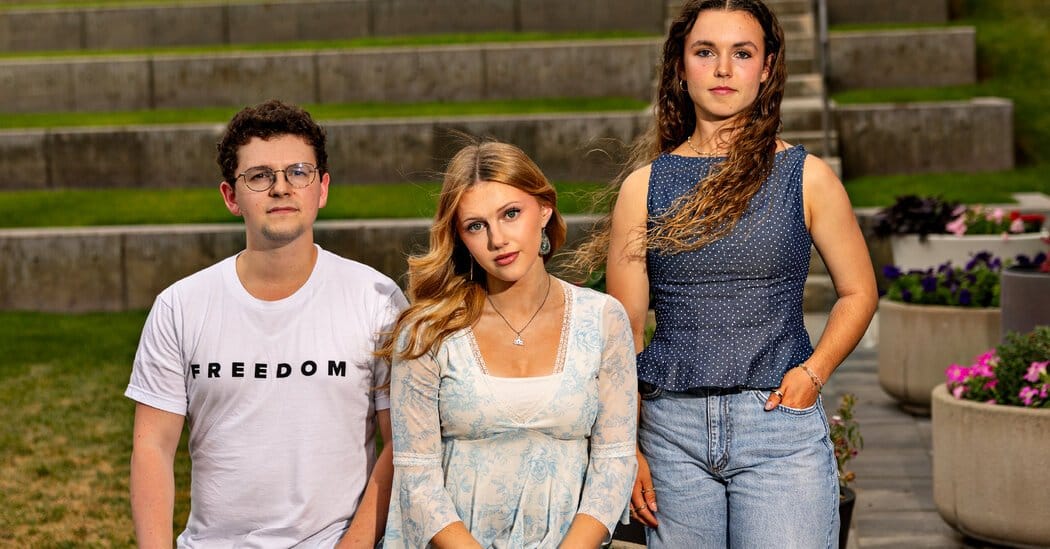
Sage Lloyd will sometimes sit by herself between classes at Utah Valley University and pray in the courtyard where she saw Charlie Kirk gunned down in September. Occasionally, strangers will walk over and, taking note of her grief about Mr. Kirk, offer to join her in prayer.
Just as often, they will want to argue with her.
“They’ll say, ‘There were two shots, not one,’ or they’ll want to debate what direction the shot came from,” Ms. Lloyd, 21, said in an interview. “I’ll try to explain what I saw with my own eyes, and they’ll tell me I’m wrong. I just got to a point where I stopped engaging.”
This fall, Ms. Lloyd will become the university’s chapter president of Turning Point USA, the conservative organization Mr. Kirk founded. She will replace Caleb Chilcutt, 24, a senior who helped persuade Mr. Kirk to come to the Orem, Utah, campus on Sept. 10 for what would be his last debate with students.
“I’m mixed up in some of the conspiracy theories because I was the chapter president at the time,” Mr. Chilcutt said in an interview. “I’d go to the courtyard just for some personal healing, and someone would come up to me and say, ‘What you people have been saying doesn’t add up.’”
Over the past year, Mr. Chilcutt, Ms. Lloyd and other Turning Point members at the university have made their way through an emotional odyssey. After watching their leader die of an assassin’s bullet on their campus at an event they helped organize, the chapter leaders have struggled to carry Mr. Kirk’s torch in a hyperpartisan political climate while managing their own psychic trauma.
They have anxiously awaited a trial for Mr. Kirk’s accused killer, Tyler Robinson, after a preliminary hearing in Provo, Utah, earlier this month concluded with the presiding judge agreeing to hear further arguments in September. They have also prodded university officials to make good on their pledge to erect a memorial in the courtyard. While acknowledging that a statue of Mr. Kirk would offend some on campus, the Turning Point chapter leaders are pressing for a tribute that explicitly refers to Mr. Kirk.
“It shouldn’t just be about unity,” said Sophie Grizzle, 19, who was also at the event on Sept. 10 and is now the chapter’s vice president. “In my opinion, it’s a historic site. And Charlie deserves to be honored.”
Not every Utah Valley student agrees. “We don’t want a hateful, bigoted man to haunt our campus,” said Leviathan Colby, a 20-year-old progressive activist.
‘Charlie’s Been Shot’
Paige Adams, a recently retired field representative for Turning Point, called Mr. Chilcutt — a native Australian and, like more than half of Utah Valley’s student body, a member of the Church of Jesus Christ of Latter-day Saints — “among the best student officers I’ve ever had.”
Every week from the time he became president in 2022, Mr. Chilcutt set up a table in the hallway of the university’s liberal arts building, where he distributed conservative literature while attempting to engage with fellow students. Some of them bantered with Mr. Chilcutt about abortion or immigration. Others made obscene gestures or called him a fascist.
Still, he regularly organized movie nights and pizza parties, where 15 students might show up. On occasion, Mr. Chilcutt managed to lure a high-profile speaker to the university, such as the former swimmer and anti-transgender activist Riley Gaines, who came in October 2024.
Uppermost in Mr. Chilcutt’s ambitions was to bring Mr. Kirk to the campus. Finally, after three years of filing speaker requests every semester with Turning Point, his wishes were granted. On Aug. 27, 2025, the group announced Mr. Kirk’s “American Comeback” debate tour of college campuses. The first stop would be exactly two weeks later, at Utah Valley.
On the morning of Sept. 10, Mr. Chilcutt and Ms. Adams oversaw preparations. The courtyard fountains were turned off, and the sound system was tested. Boxes of MAGA caps were assembled near the tent where Mr. Kirk would sit and field questions. The 3,000 attendees, far more than Utah Valley officials had projected, were guided to positions along the courtyard’s grassy steps. Six campus police officers patrolled the throng.
The S.U.V. ferrying Mr. Kirk, 31, arrived at about noon. He gazed appreciatively at the swelling audience while walking with a security team toward the courtyard and said, according to one of his staff members, “Today’s going to be a great day.”
Mr. Chilcutt and Mr. Kirk exchanged a brief greeting behind the tent. They posed for a photograph. Then Mr. Chilcutt stepped up to the courtyard microphone, introduced himself as Turning Point’s campus president and urged the crowd to welcome Mr. Kirk. The Turning Point leader and Mr. Chilcutt proceeded to fling MAGA caps into the crowd.
Ms. Lloyd was standing in front of the stage as students around her chanted, “U.S.A.! U.S.A.!” She texted her family back home in San Antonio to convey her excitement. “It was so electric to be surrounded by people who were like-minded,” she recalled.
At 12:23 p.m., just after a student challenged Mr. Kirk’s assertion about the propensity of transgender people to commit violence, a shot was fired. Ms. Grizzle watched Mr. Kirk fall out of his chair just a few feet in front of her. Her first reaction, she said, was, “Is this a skit about gun violence? Then I saw the blood coming out of his neck.”
From her angle, Ms. Lloyd could see the rivulet of blood spatter the grass. She immediately fell to the ground with the other students. Mr. Chilcutt, who had been ushered off by security to a perch above the tent, at first mistook the sound for a collision. He called Ms. Adams, who frantically informed him: “Charlie’s been shot. You need to leave right now.”
The campus was closed down for a week. Mr. Chilcutt spent the first day sequestered at home with his wife, Brooke, terrified that the gunman, who was still at large, might be targeting other Turning Point officials. Ms. Lloyd could not sleep or even pray because of the image of Mr. Kirk that returned when she closed her eyes.
The atmosphere greeting the Turning Point students when classes resumed on Sept. 17 was leaden with mixed emotions. “I had some people who used to scream at us or flip us off say, ‘I’m so sorry what happened,’” recalled Mr. Chilcutt. Other classmates, Ms. Lloyd said, “were making jokes about it, laughing about it, imitating what happened.” Ms. Grizzle remembered one of her teachers offering a somber reflection on Mr. Kirk’s assassination — a surprise, she said, since the same teacher had ridiculed the Turning Point leader in class on the morning of the shooting.
The Turning Point table soon returned to its usual weekly spot in the liberal arts corridor. Supporters of Mr. Kirk showed up to commiserate. By the end of the year, the university’s chapter’s previous membership of roughly 100 had tripled, and its Instagram audience had jumped from 1,000 to 12,000 followers.
In December, Mr. Chilcutt was making plans to attend Turning Point’s annual AmericaFest in Phoenix when a senior staff member texted him and instructed the chapter president to bring a suit. Upon arriving in Phoenix, Mr. Chilcutt was informed that he would be receiving Turning Point’s Student of the Year award, except that it had been renamed the Charlie Kirk Courage Award.
New Groups on the Left
By early 2026, some progressives on campus became fretful that sympathy for Turning Point would obscure Mr. Kirk’s divisive rhetoric. “This is a guy who said a lot of hateful things about us,” said Mr. Colby, who is gay. Two new groups on the left, the Students for a Democratic Society (inspired by the 1960s movement and refounded in 2006) and the Civil Disobedience Club, materialized on campus and began to set up tables near Turning Point. Hoping to make peace with them, Mr. Chilcutt sidled up to the S.D.S. table one afternoon.
“None of us wanted to talk with him,” said Collin Grannis, the founder of the university’s S.D.S. chapter. “It was very awkward.”
In late March, the university’s president at the time, Astrid S. Tuminez, announced that Sharon McMahon, a best-selling author of inspirational nonfiction, would deliver the commencement address that spring. Ms. McMahon had lamented Mr. Kirk’s death in a Facebook video post the day of his assassination but, two days later, she said in part, “It’s important to remember that the incredible tragedy of a public assassination does not erase the harm many experienced from his words and the ensuing actions his followers took.”
Ms. Lloyd was angry. “They could have picked anybody from an entire constellation of speakers and we probably would have been OK with it,” she said. “But for those of us still grieving Charlie’s death, selecting her was just bad taste.”
The chapter joined Turning Point officials and other leaders on the right, including Senator Mike Lee, the Utah Republican, in condemning Ms. Tuminez’s choice of Ms. McMahon. Mr. Chilcutt released his own statement on behalf of the university’s chapter, describing Ms. McMahon’s reaction to Mr. Kirk’s killing as “tone-deaf and disrespectful to those still affected, especially on this campus.” (Ms. McMahon declined a request for comment; Ms. Tuminez did not respond to a similar request.)
After a weekslong pressure campaign, Ms. Tuminez withdrew Ms. McMahon’s speaking invitation, citing security concerns. The graduation exercises continued without a featured commencement speaker.
“We ended up looking like the bad guy,” Ms. Lloyd said. “We got accused of participating in cancel culture and going against the very things Charlie advocated for.”
On a hot July afternoon, Mr. Chilcutt stood in the empty courtyard of Utah Valley University. The grassy area where Mr. Kirk fell bleeding to the ground has been paved over, with a few large flowerpots on top of it. Off to what had been Mr. Kirk’s stage left, a new flagpole has been erected. A committee of state and school officials has continued to deliberate over what sort of memorial would be a fitting addition to the area.
“My main concern has been that the voices for commemorating Charlie will start to die down,” Mr. Chilcutt said. And the voices from the Students for a Democratic Society and the Civil Disobedience Club, he added, “will be the only ones left.”