

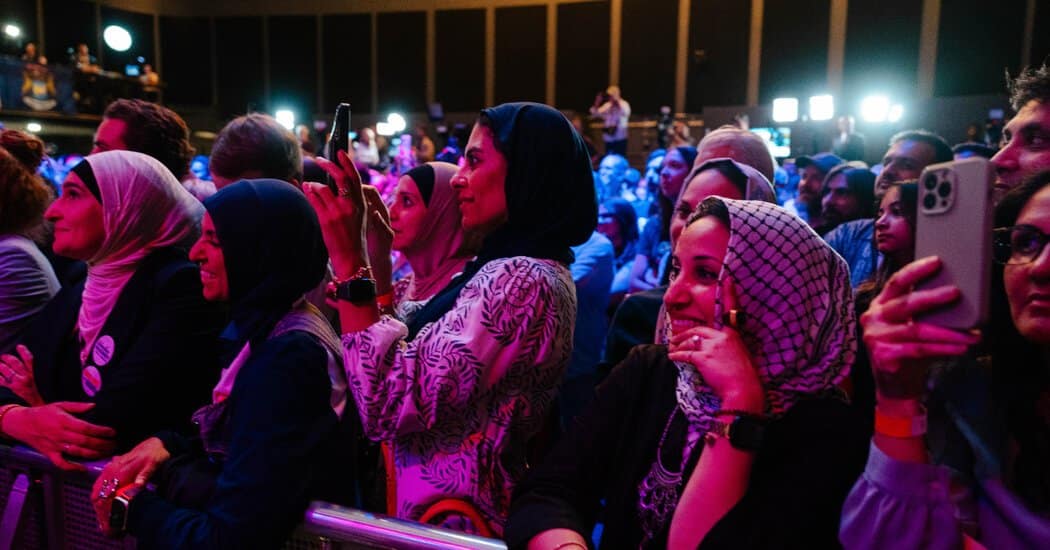
Muslim American voters celebrated Abdul El-Sayed’s narrow victory in Michigan’s Democratic Senate primary on Wednesday, declaring they had found a place in American politics even amid a rise in fiercely anti-Muslim political rhetoric, especially in the South.
Dr. El-Sayed’s win against a centrist congresswoman funded by pro-Israel groups and backed by the party establishment was especially sweet in Eastern Michigan, where Arab and Muslim Americans have long lived.
Dr. El-Sayed, a Michigan-born son of Egyptian immigrants, could become the nation’s first Muslim senator if he wins the general election in November against a former Republican House member, Mike Rogers.
“Growing up as a Muslim American, you’re often told to conceal that part of your identity if you want to get ahead,” Bilal Baydoun, 36, a writer and political strategist from Dearborn, Mich., said Tuesday night at Dr. El-Sayed’s election party in Detroit. “To see him bear his name with his full chest — even saying his full name at times — it still feels revolutionary in a way.”
Dr. El-Sayed’s primary opponent, Representative Haley Stevens, received tens of millions of dollars from the super PAC-arm of the American Israel Public Affairs Committee, the country’s most influential pro-Israel group. Israel, which Dr. El-Sayed has criticized for its actions in Gaza and elsewhere, was a fault line in the primary race, as it was in 2024, when Muslims criticized Kamala Harris.
“The Palestinian narrative is being heard, and the American people are awakening to what is happening,” said Tarek Khalil, 41, a Palestinian activist and lawyer from Chicago.
Nishi Rahman, 26, a health care consultant who lives in New York City, said he started following Dr. El-Sayed’s career during his 2018 run for governor of Michigan.
“I didn’t think there was a place for me in politics as a Muslim kid growing up,” said Mr. Rahman, recalling anti-Muslim sentiment in the United States after the Sept. 11, 2001, terrorist attacks.
“What this shows is that we as Muslims have a place here,” he said. “We can be full citizens of this country. We can be leaders here. And we’re just as American as anybody else.”
Farah Chalisa, a human rights lawyer from Chicago whose parents emigrated from Pakistan, said much of her life had been defined by anti-Muslim sentiment. She was in second grade on Sept. 11.
“It means so much to me as a Muslim American to see a Muslim man potentially become a senator,” said Ms. Chalisa, 32, adding, “It makes me feel like I belong.”
The general election race could be crucial for Democrats’ chances of winning control of the Senate, and the National Republican Senatorial Committee on Wednesday quickly posted a digital ad labeling Dr. El-Sayed “the most radical Senate candidate in America.” The ad uses Dr. El-Sayed’s full name, Abdulrahman Mohamed El-Sayed.
Already, anti-Muslim rhetoric has been used by candidates in Texas, Tennessee and Alabama.
Mr. Baydoun said he felt anxious about the potential vitriol in response to Dr. El-Sayed’s primary victory.
“It’s going to be bittersweet because I know that even if he wins, tomorrow and the day after is going to be a contest of who can demonize Muslims more,” Mr. Baydoun said. “I’m worried about what that means for my family and my community.”