



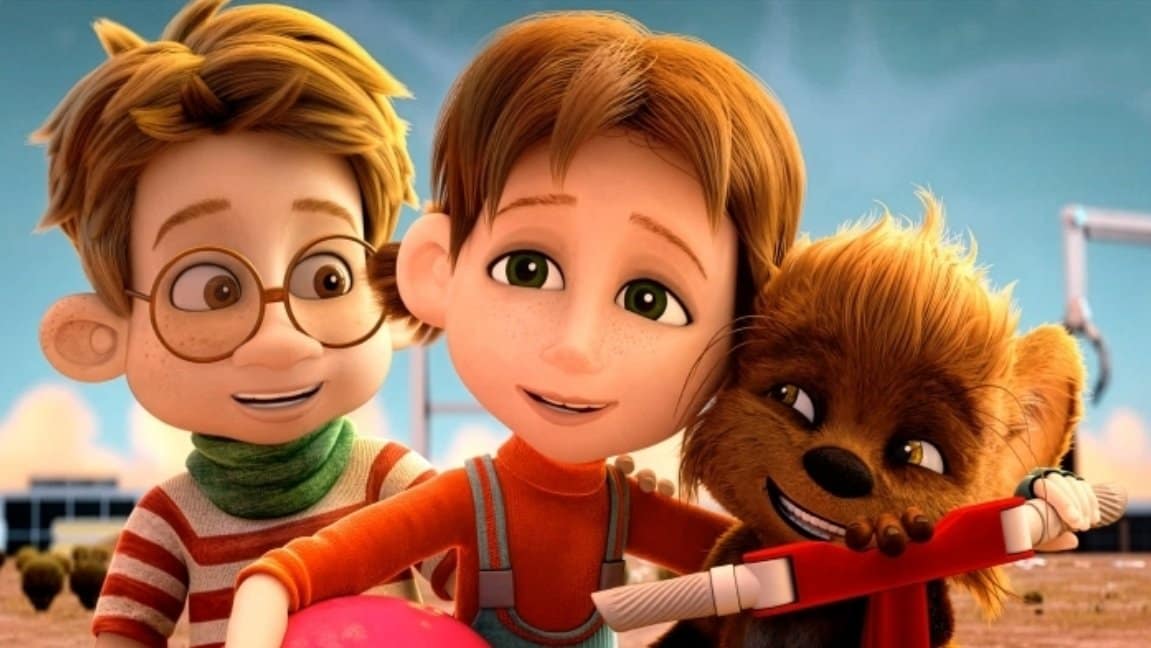
– Sourced from a story by Dušan Vukotić, Arsen Anton Ostojić’s animated feature portrays ecology, responsibility, friendship and adventure clashing with greed and corruption

After the death of the only Yugoslav Oscar winner, Dušan Vukotić (1927-1998), who won his statuette for the animated short The Substitute (1961), it took Croatian filmmaker Arsen Anton Ostojić a decade to ask for and acquire the rights to film Vukotić’s unfinished feature-length animated project The Crystal Planet, for which the latter also wrote the story. It was a further decade or so before Ostojić actually started making the project come to life. The modern animated feature is now completed and ready to be presented to a worldwide audience. After its world premiere at the Zlín Film Festival, it was presented to the Croatian public at the Pula Film Festival, where it won the Special Golden Arena for its contribution to Croatian animation (see the news).
After her mother’s death in an accident, 11-year-old girl Rea reluctantly moves with her engineer father, Val, to the titular crystal planet in order to start a new life. The father is about to begin a new job as the right-hand man to the robot-factory owner and ruler of the planet, Governor Mordokan. The entrepreneur’s newest inventions are (still glitchy) robotic pets, as animals are forbidden on the planet. Elections are just around the corner, and Val’s efforts are needed to secure the governor’s victory against rival candidate Sandra, who campaigns on environmental issues.
All Rea wants is to go back to Earth, which she still calls home. But things begin to change when she meets and befriends her next-door neighbour, Sandra’s son Andy. On one of their first adventures, they encounter and save the cub of a local animal species and realise that the planet has its own ecosystem that is being endangered by the pollution created by Mordokan’s factory. They try to keep their find a secret, but the revelation threatens to rewrite all of the rules on the planet. Two single-parent families, with the help of the intelligent and empathetic species, must therefore fight the establishment.
The Crystal Planet is clearly aimed at younger audiences, so one shouldn’t expect any kind of nuance in delivering its environmentally conscious message. The heroes and villains simply wear their allegiances, and often their thoughts and inner turmoil, on their sleeves. The storytelling also suffers from some deus ex machina plot devices and twists, while mimicking the US style of children’s animation and even introducing a couple of songs as transitions between the acts. However, the script written by Ostojić, Aleksandar Žiljak and Brett Shumway redeems itself with some warm-hearted humour and a good helping of sincerity.
On the technical side, the combination of model-based animation and CGI serves its purpose perfectly well, as it is blended together smoothly, so the work of the team of animators should be commended. The same goes for Tomáš Sysel’s cinematography, which creates the sense of a well-rounded world while capturing the heroes in action and the rich background textures at the same time. Arsen Anton Ostojić’s sure-handed directing might come as a surprise for an animation first-timer (although he did co-produce one such title, The Oddsockeaters, back in 2016), and the editing by Lucie Haladová helps everything flow smoothly while keeping the running time around the 90-minute mark.
The Crystal Planet is a very ambitious film. The existence of dubbed versions in several languages, including the worldwide one in English (voiced by, among others, Jeremy Irons, Vanessa Redgrave and Michael York), could help the movie cross several borders. In the context of Croatian cinema, it is a valuable addition to the recently revived tradition of feature-length animation for younger audiences.
The Crystal Planet was staged as a co-production between Croatia, the Czech Republic and Slovakia through Filmosaurus Rex, Alkay and Bfilm, with the participation of Czech Television. Sola Media handles the sales.